

Lab-Grown Diamonds vs. Mined — The Truth No One Tells You
Lab-Grown Diamonds vs. Mined: The Truth the Industry Doesn't Lead With
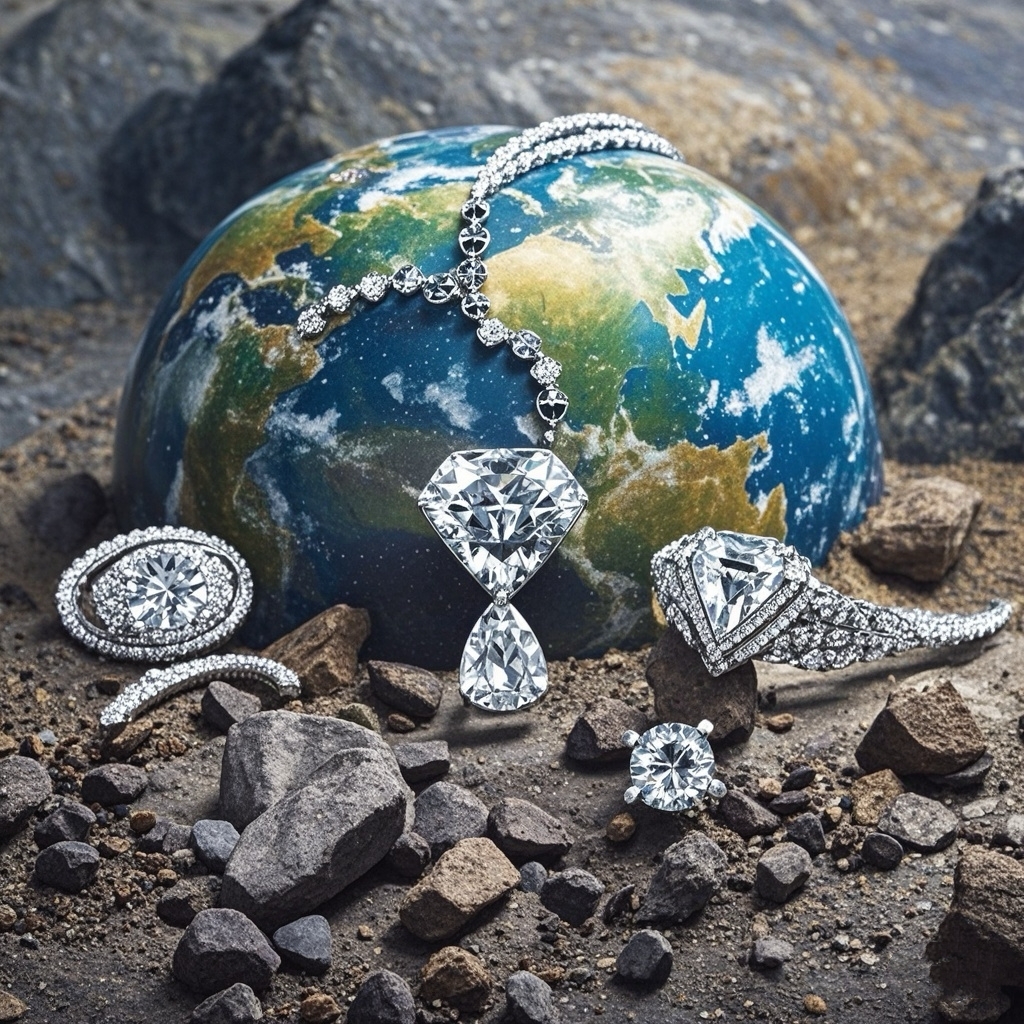
For over a century, the diamond industry has told us one story — and it's a beautiful one. A diamond, we're told, is precious because it's rare. Because it formed over billions of years in the crushing heat of the Earth's mantle. Because it was carried to the surface by volcanic forces, discovered by miners, and transformed by skilled cutters into the glittering stone on your finger.
It's a compelling narrative. It sells diamonds. But it omits several inconvenient truths that the industry would prefer you didn't examine too closely.
Here's what that story leaves out: mining a single one-carat diamond requires moving approximately 250 tonnes of earth. That's roughly the weight of 40 adult African elephants — displaced, processed, and discarded for a stone that fits on your fingertip. It leaves out the fact that diamond supply chains are notoriously opaque — a single stone can pass through five or more countries between mine and market, making true origin tracing nearly impossible. And it leaves out the uncomfortable reality that diamond prices are not driven by natural scarcity, but by carefully managed supply control that has artificially inflated prices for decades.
Lab-grown diamonds change this story entirely. Not by being "fake" diamonds — this is the single biggest misconception and one we need to address immediately — but by being real diamonds with a cleaner, fully traceable, and radically more transparent origin story.
Let's Settle the "Real" Question Once and For All
This is the question that comes up in every conversation about lab-grown diamonds, so let's address it directly and definitively: Are lab-grown diamonds real diamonds?
Yes. Unequivocally. Without qualification.
A lab-grown diamond is chemically, physically, and optically identical to a mined diamond. Let's break down exactly what that means:
- Chemical composition: Pure carbon (C), arranged in a cubic crystal lattice. This is the defining characteristic of diamond. If it's pure carbon in a diamond cubic structure, it's a diamond — regardless of where it formed.
- Hardness: 10 on the Mohs scale. The hardest material known to exist. A lab-grown diamond will scratch anything except another diamond — exactly like a mined stone.
- Refractive index: 2.42. That signature brilliance — the way light bends and bounces inside the stone, creating the sparkle we associate with diamonds — is identical.
- Thermal conductivity: Diamond testers (the devices jewellers use to distinguish diamond from imitations like cubic zirconia) cannot tell the difference. They register both as diamond — because both are diamond.
- Crystal structure: Face-centred cubic. The atoms are arranged in exactly the same pattern. Under an electron microscope, the lattice is indistinguishable.
Even a trained gemologist with decades of experience cannot tell a lab-grown diamond from a mined diamond using a jeweller's loupe. They require specialised spectroscopy equipment — machines that analyse trace elements at the parts-per-billion level — to detect the subtle growth patterns that differ between HPHT (high pressure high temperature), CVD (chemical vapour deposition), and natural formation. These are forensic-level differences, not visible differences. To the naked eye — and to the standard tools of gemmology — they are the same stone.
The Federal Trade Commission in the United States ruled in 2018 that lab-grown diamonds are indeed diamonds. The Gemological Institute of America (GIA) grades lab-grown diamonds using the same 4Cs (cut, colour, clarity, carat) as mined diamonds. The International Gemological Institute (IGI) — widely used in Europe — provides full certification for lab-grown stones. This is not a fringe opinion. It is the consensus of every major gemological authority in the world.
The distinction that matters: Lab-grown diamonds are not "synthetic" in the way that cubic zirconia or moissanite are. Those are different materials — diamond simulants that look similar but have different chemistry. A lab-grown diamond is a diamond. The only thing that's different is how it came into existence — in a controlled laboratory rather than in the Earth's mantle. And that difference, as we'll explore, is almost entirely positive.
How Are They Made? The Science in Plain Language
There are two main methods for creating lab-grown diamonds. The one we use at LOTTEDS — and the one that produces the highest-quality gem-grade stones — is HPHT (High Pressure High Temperature).
Here's the process, step by step:
- The Seed: A tiny diamond seed crystal — a sliver of existing diamond, roughly the size of a grain of sand — is placed in a growth chamber along with a carbon source, typically highly purified graphite.
- The Conditions: The chamber is pressurised to over 50,000 atmospheres — that's roughly the pressure you'd experience at 500 kilometres below the Earth's surface, deep in the mantle where natural diamonds form. Simultaneously, it's heated to temperatures between 1,300°C and 1,600°C. At these extremes, the carbon source melts and dissolves.
- The Growth: The dissolved carbon begins to crystallise around the diamond seed — atom by atom, layer by layer — building the exact same cubic crystal structure as a natural diamond. The process is controlled with extraordinary precision: temperature within ±5°C, pressure within ±1%, growth rate measured in microns per hour.
- The Result: After several weeks, a rough diamond crystal emerges from the chamber — chemically, structurally, and optically identical to a rough diamond pulled from a mine. It's then cut and polished by the same master cutters who work on mined stones, using the same tools and techniques.
The entire process takes weeks instead of billions of years. But the physics is the same. The chemistry is the same. The result is the same. The only difference is the location of the laboratory — a controlled facility in a developed country, rather than a volcanic pipe in a remote region with an opaque supply chain.
The Environmental Equation: By the Numbers
This is where the difference between lab-grown and mined becomes stark — and for European consumers who increasingly factor sustainability into purchasing decisions, these numbers matter.
| Environmental Impact | Mined Diamond (per carat) | Lab-Grown Diamond (per carat) |
|---|---|---|
| Earth moved | ~250 tonnes | 0 tonnes |
| CO₂ emissions | ~57 kg | ~0.5 kg |
| Water consumption | ~480 litres | ~70 litres |
| Land disruption | Permanent landscape alteration; open-pit mines visible from space | Contained laboratory footprint |
| Ecosystem impact | Habitat destruction, water table disruption, soil erosion | Minimal; regulated industrial facility |
| Traceability | Often opaque; multiple intermediaries across countries | 100% traceable from laboratory to jewellery box |
Let's put that 250 tonnes figure into perspective. The average European family car weighs about 1.5 tonnes. Mining one carat of diamond requires moving the equivalent of 167 cars' worth of earth. For a one-carat engagement ring — the classic choice across Europe — that's what's displaced. And after the diamond is extracted, the landscape remains permanently altered. Open-pit diamond mines are among the largest human-made excavations on Earth — some are visible from the International Space Station.
The CO₂ difference is equally dramatic. At 57 kg per carat, a single one-carat mined diamond has a carbon footprint equivalent to driving a typical petrol car from Paris to Berlin (approximately 1,050 km). A lab-grown diamond, at 0.5 kg per carat, has a footprint equivalent to driving about 9 km — roughly the distance from the centre of Paris to the nearest suburb.
The Price Difference — And Why It Exists
If lab-grown and mined diamonds are identical, why does one cost 60–70% less? The answer reveals a great deal about how the traditional diamond market actually works.
Mined diamond prices are not set by a free market responding to natural supply and demand. For most of the 20th century, a single company — De Beers — controlled approximately 80–90% of the global diamond supply. They managed the flow of diamonds into the market with extraordinary precision, releasing just enough stones to meet demand while withholding the rest to maintain price levels. The famous slogan "A Diamond Is Forever" — created by De Beers in 1947 — was not just marketing. It was a strategic effort to discourage resale. If people never sold their diamonds, the market wouldn't be flooded with second-hand stones, and prices would stay high.
While De Beers' market share has declined from its peak, the structure of the industry remains oligopolistic. A small number of companies — ALROSA (Russian, state-influenced), De Beers (Anglo American), Rio Tinto, and a few others — still control the majority of rough diamond production. They manage supply carefully. They set prices at invitation-only "sights" where approved buyers (sightholders) are offered boxes of stones at non-negotiable prices. This is not a free market. It's a managed one.
Lab-grown diamonds bypass this entirely. They are produced by technology companies in competitive markets. Supply responds to demand, not to a cartel's strategic release schedule. There are no "sights." No non-negotiable boxes. No artificially constrained supply. The price reflects what it actually costs to produce the stone — plus a reasonable margin — rather than what a century-old supply chain has decided the market will bear.
The result: a lab-grown diamond of identical quality costs 60–70% less than its mined equivalent. The stone is the same. The sparkle is the same. The hardness is the same. The price reflects reality — not managed scarcity.
Ethics and Traceability: Why This Matters for European Buyers
European consumers are among the most ethically conscious in the world. The EU's regulatory framework — particularly around supply chain transparency, conflict minerals, and sustainability reporting — reflects this. And it's here that lab-grown diamonds offer their most compelling advantage.
A mined diamond's journey from earth to ring can involve five or more countries: a mine in Botswana or Russia, cutting in India or Israel, trading in Antwerp, retail in London or Paris. Each step introduces opacity. Despite the Kimberley Process — the international certification scheme established in 2003 to prevent "conflict diamonds" from entering the market — the system has well-documented limitations. The Kimberley Process only covers diamonds used to fund rebel movements against recognised governments. It does not address environmental destruction, labour conditions, or diamonds associated with state-sanctioned violence. It's a narrow instrument — and many experts argue it's insufficient for today's ethical standards.
In 2024, the G7 nations — including Germany, France, and Italy — imposed additional sanctions on Russian-origin diamonds, reflecting growing concern about the role of diamond revenues in geopolitics. Tracing a diamond's origin through multiple cutting and trading centres, however, remains extremely difficult in practice.
A lab-grown diamond has none of these issues. It's created in a single facility. It's cut in a single workshop. It's set in a single piece of jewellery. The entire supply chain — from carbon source to finished stone — is measured in metres, not thousands of kilometres. You can know — with certainty — where your diamond came from, who made it, and under what conditions. In an era of increasing supply chain regulation and consumer expectation, that level of transparency is not a luxury. It's rapidly becoming the minimum standard.
At LOTTEDS, we also offer moissanite — a gemstone with even greater fire and brilliance than diamond, originally discovered in meteorites and now ethically grown in laboratories. Moissanite offers an additional choice for those seeking maximum sparkle with zero mining footprint. Read our full moissanite guide →

Lab-Grown Brilliance in the Bob Collection
Our Bob Collection features lab-grown diamonds and moissanite set in 316L surgical steel with PVD 18K gold. The sparkle is real; the environmental footprint is minimal.
Explore Bob → · Giorno Collection →
Rings with a Clear Conscience
From engagement-worthy rings to everyday bands, every LOTTEDS ring with lab-grown stones is fully traceable — from lab to your hand.
Shop Rings → · Starlet Shimmer →
Earrings That Sparkle Responsibly
Our lab-grown gemstone earrings deliver the fire and brilliance you want — without the environmental cost you don't. 316L steel means no irritation, even for sensitive ears.
Shop Earrings → · Aura Collection →Common Questions About Lab-Grown Diamonds
Do lab-grown diamonds hold their value?
This is a fair question, and it deserves an honest answer. Lab-grown diamonds currently have lower resale value than mined diamonds — this is true. However, mined diamonds also depreciate significantly from their retail price. The common belief that "diamonds are an investment" is largely a marketing creation. A mined diamond purchased at retail for €5,000 might resell for €1,500–2,500. The markup is in the retail experience, not the stone's intrinsic value.
Our perspective: buy a diamond — lab-grown or mined — because you love it and want to wear it. Not as a financial investment. If what you want is maximum beauty, maximum ethical clarity, and a price that reflects reality rather than a managed market, lab-grown is the rational choice. And with the savings (60–70% less than mined), you could buy a larger, higher-quality stone — or invest the difference in something that actually appreciates.
Can a jeweller tell the difference?
Not with standard tools. A jeweller's loupe, a thermal conductivity tester, even a microscope — none can distinguish a lab-grown diamond from a mined one. Only specialised spectroscopy equipment — costing tens of thousands of euros and found primarily in gemological laboratories — can detect the trace-element signatures that differ between growth methods. Your local jeweller cannot tell them apart. Your friends cannot tell them apart. You cannot tell them apart. Because they are the same thing.
Are lab-grown diamonds graded?
Yes. The IGI (International Gemological Institute) and GIA (Gemological Institute of America) both grade lab-grown diamonds using the same 4Cs — cut, colour, clarity, and carat weight — as mined diamonds. Every LOTTEDS piece featuring lab-grown stones comes with full grading documentation.
The Bottom Line
A diamond is a diamond. What differs is the story behind it — and the price you pay for that story.
If you value sustainability, traceability, and receiving more brilliance for your budget, lab-grown is not simply an alternative to mined. It is, by every objective measure, the more considered choice. You get the same stone. The same fire. The same hardness. The same sparkle on your hand or at your neck. What you don't get is 250 tonnes of displaced earth per carat, an opaque supply chain stretching across continents, or a price inflated by a century of supply manipulation.
For European buyers — who increasingly demand transparency, sustainability, and value — lab-grown diamonds represent not a compromise, but an evolution. The question isn't "why choose lab-grown?" It's "why would you choose anything else?"
Discover Lab-Grown Diamond Jewellery
Bob Collection → Shop Rings → Giorno Collection → Our Sustainability Pledge →Read: Moissanite Guide → · Materials & Craftsmanship → · How We Price Our Jewellery →
Leave a comment