

Moissanite — The Gemstone That Outshines Diamond
Moissanite: The Gemstone That Outshines Diamond — And Comes From the Stars
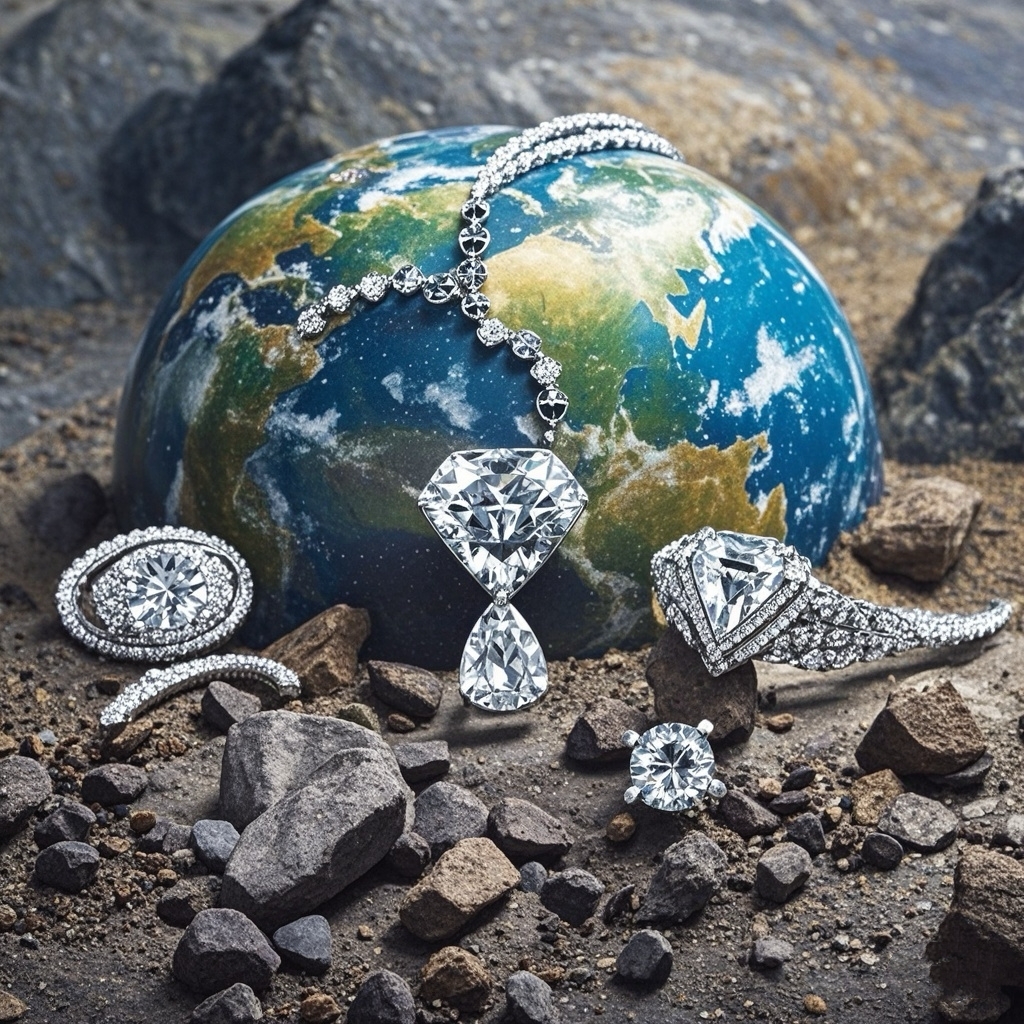
If you haven't heard of moissanite yet, you will. It's the gemstone that's quietly transforming the jewellery industry — offering more fire than diamond, greater brilliance per euro, and an origin story that literally begins in the stars. Not in a poetic sense. In a literal, "this mineral was first discovered in a meteorite crater" sense.
Moissanite is not a diamond simulant. It's not a "fake diamond." It's a distinct gemstone with its own chemical composition, its own optical properties, and its own remarkable story. And for European consumers who value sustainability, transparency, and getting the most beauty for their money, it represents one of the most compelling choices in modern jewellery.
A Discovery from Outer Space
In 1893, French chemist Henri Moissan — already a pioneer in his field, later to win the Nobel Prize in Chemistry — was examining rock samples from the Barringer Meteor Crater in Arizona. Among the fragments of meteoric iron, he noticed tiny, brilliantly sparkling crystals that he initially assumed were diamond. They had the same lustre. The same hardness. The same way of catching and throwing light.
But when he analysed them in his laboratory at the Sorbonne, he discovered something extraordinary: these crystals were not carbon. They were silicon carbide (SiC) — a compound that had never before been found in nature. The mineral was later named moissanite in his honour.
For nearly a century, natural moissanite remained one of the rarest minerals on Earth — found only in meteorites and a handful of microscopic inclusions in kimberlite (the volcanic rock that hosts diamonds). It was simply too scarce for commercial jewellery. Then, in the late 20th century, materials scientists developed a method to grow silicon carbide crystals in controlled laboratory conditions — initially for industrial applications like high-power electronics and abrasives. It didn't take long for gemmologists to realise that this lab-grown material, when cut and polished, produced a gemstone of exceptional beauty.
Today, all moissanite used in jewellery is lab-grown. Natural moissanite is still virtually nonexistent outside of meteorites and scientific collections. This means that every moissanite gem on the market is fully traceable, conflict-free, and created with zero mining. It's one of the few gemstones where the entire supply chain — from raw material to finished stone — is measured in metres, not thousands of kilometres.
What Makes Moissanite Special: The Optical Properties
To understand why moissanite is so visually striking, you need to understand three concepts that gemmologists use to describe how a stone interacts with light:
- Brilliance is the amount of white light that enters the stone, bounces around inside, and reflects back to your eye. It's measured by the refractive index — the degree to which the stone bends light as it passes through. A higher refractive index means more light is reflected internally, creating more sparkle.
- Fire (or dispersion) is the stone's ability to split white light into its spectral colours — the rainbow flashes you see when light hits the gem at certain angles. It's measured by the dispersion value. A higher dispersion means more rainbow fire.
- Scintillation is the pattern of light and dark areas that appear as the stone, the light source, or the viewer moves. It's the "sparkle pattern" — the dynamic, dancing light that makes a gem feel alive.
Here's how moissanite compares to diamond across these three dimensions, plus hardness:
| Property | Moissanite | Diamond | What This Means |
|---|---|---|---|
| Refractive Index (Brilliance) | 2.65–2.69 | 2.42 | Moissanite reflects more light — it's objectively more brilliant |
| Dispersion (Fire) | 0.104 | 0.044 | Moissanite has more than double the fire of diamond — significantly more rainbow flashes |
| Hardness (Mohs Scale) | 9.25 | 10 | Diamond is harder, but moissanite is harder than sapphire and ruby (both 9) — more than hard enough for daily wear |
| Toughness | Excellent | Good (but has cleavage planes) | Moissanite is less likely to chip than diamond under impact |
| Colour | Near-colourless (equivalent to G–H on the diamond scale) | D–Z colour range | Premium moissanite is visibly colourless to the untrained eye; some may notice a slight warmth in larger stones |
| Price (per carat equivalent) | ~€40–€200 | ~€2,000–€20,000+ | Moissanite costs a fraction of diamond — 90–98% less |
In plain terms: moissanite sparkles more, flashes more rainbow colours, is hard enough to last a lifetime, and costs dramatically less. The only dimension where diamond clearly wins is hardness — and at 9.25 on the Mohs scale, moissanite is harder than any gemstone except diamond. It's more than durable enough for an engagement ring worn every day for fifty years.
The fire difference is real and noticeable: Moissanite's dispersion of 0.104 means that when you move the stone under a light source, it throws distinct rainbow flashes. Diamond's dispersion of 0.044 produces a more subtle, predominantly white sparkle. Neither is "better" — they're different aesthetic experiences. Some people prefer diamond's crisp white brilliance. Others love moissanite's celebratory rainbow fire. It's a matter of personal preference, not a hierarchy of quality.
Is Moissanite "Fake"?
This is the question that arises in almost every conversation about moissanite, and it deserves a direct answer: No. Moissanite is not a fake diamond. It is a distinct gemstone with its own identity.
A "fake" or "simulant" is a material designed to mimic another material while being chemically different. Cubic zirconia (CZ) is a diamond simulant — it's made of zirconium dioxide, looks vaguely like diamond to an untrained eye, but has different optical properties, scratches easily, and clouds over time. CZ is to diamond what imitation vanilla is to vanilla — a cheap approximation.
Moissanite is different. It has its own chemical formula (SiC, not C). Its own crystal structure (hexagonal, not cubic). Its own optical signature — the double refraction that creates its characteristic fire is a property diamond doesn't possess. It's not trying to be diamond. It's a gemstone in its own right — like a sapphire is a gemstone, or a ruby is a gemstone. The fact that it's colourless and brilliant doesn't make it "fake diamond" any more than a white sapphire is a "fake diamond."
At LOTTEDS, we offer both lab-grown diamonds and moissanite — because we believe they're both valid, beautiful choices, and which one you prefer depends on what you value most. If you want the exact chemical composition of diamond with a crisp, predominantly white sparkle, choose lab-grown diamond. If you want maximum fire, more brilliance, a truly unique origin story, and exceptional value, choose moissanite. Neither is the "wrong" choice. They're different answers to different preferences.
Why Moissanite Is the Ethical Choice
For European consumers — who consistently rank sustainability and ethical production among their top considerations when purchasing jewellery — moissanite offers a uniquely clean profile:
- Zero mining: Every moissanite stone is grown in a laboratory. No earth displaced. No ecosystems disrupted. No communities affected by mining operations. The entire environmental impact of a moissanite gem is the energy used to grow the crystal — and that energy can be sourced from renewables.
- Full traceability: A moissanite's journey from raw silicon carbide powder to finished gem is contained within a single facility or a small network of facilities. You can know exactly where your stone came from — something that remains difficult for mined gemstones, even with certification schemes.
- No conflict footprint: Unlike mined diamonds and coloured gemstones, whose supply chains have historically been vulnerable to exploitation, moissanite has no association with conflict. The laboratory environment in which it's created is regulated, inspected, and safe.
- Exceptional durability = less waste: Moissanite's hardness (9.25 Mohs) means it will not scratch, chip, or cloud over a lifetime of wear. A moissanite ring bought today will look as brilliant in 50 years. The most sustainable product is one you never need to replace.
At LOTTEDS, we also offer lab-grown diamonds for those who prefer the classic diamond sparkle with full traceability and zero mining. Both stones are available across our collections — you choose the brilliance that speaks to you. Lab-grown vs. mined: the full comparison →
Moissanite and the EU Consumer
European jewellery buyers are among the most discerning in the world. They ask questions that consumers in other markets often don't: Where did this stone come from? Who made it? Under what conditions? What will happen to it when I'm gone? Moissanite answers all of these questions with a clarity that few other gemstones can match.
The EU's regulatory framework increasingly demands supply chain transparency. The Conflict Minerals Regulation (EU 2017/821) requires importers of certain minerals to conduct due diligence on their supply chains. While diamonds are not yet fully covered by this regulation, the direction of travel is clear: transparency is becoming mandatory, not optional. Moissanite — with its fully traceable, laboratory-based production — is already compliant with the highest standards of supply chain transparency. There is no opacity because there is nothing to hide.
For the European consumer who wants to make a purchase they can feel good about — environmentally, ethically, and aesthetically — moissanite is not a compromise. It's arguably the most coherent choice available.

Moissanite in the Giorno Collection
Our Giorno Collection features moissanite stones that capture the warmth of the Mediterranean sun. Set in 316L steel with PVD 18K gold — hypoallergenic, water-resistant, and brilliant beyond measure.
Giorno → · Bob Collection →
Rings That Sparkle Forever
From everyday bands to show-stopping Starlet Shimmer designs, our moissanite rings deliver fire and brilliance at a fraction of diamond's cost — with zero mining footprint.
Shop Rings → · Starlet Shimmer →
Earrings That Light Up the Room
Moissanite earrings catch every flicker of light — ideal for evenings, events, or simply making an ordinary Tuesday feel extraordinary. Hypoallergenic 316L steel means no irritation, even after hours of wear.
Shop Earrings → · Aura Collection →Common Questions About Moissanite
Will moissanite cloud or discolour over time?
No. This is a common misconception — likely inherited from cubic zirconia, which does absorb oils and become cloudy with wear. Moissanite is a single-crystal material with a hardness of 9.25. It does not absorb anything. It does not oxidise. It does not cloud. A moissanite stone will look as brilliant on its fiftieth anniversary as it did on its first day. This is one of the reasons we offer a Lifetime Warranty on all LOTTEDS pieces — the materials are built to last.
Can people tell it's not diamond?
To the naked eye, even to most jewellers using standard tools, the difference is not obvious. Moissanite's higher refractive index and fire actually make it appear more brilliant than diamond — so if anything, people tend to assume it's an exceptionally high-quality diamond. Under magnification, a trained gemologist can identify moissanite by its double refraction (diamond is singly refractive) and its characteristic needle-like inclusions. But in daily life — at a dinner table, across a meeting room, on your hand as you gesture — it reads as a stunning, colourless, brilliantly sparkling gem. Which, of course, it is.
Is moissanite graded like diamond?
Moissanite is not graded on the diamond 4Cs scale because it's a different material. However, reputable moissanite producers do grade their stones for colour (typically D–F equivalent for premium stones), clarity (typically VS equivalent or better), and cut quality. At LOTTEDS, we source only premium-grade moissanite that is near-colourless and eye-clean — meaning you won't see any inclusions with the naked eye.
How does moissanite perform in an engagement ring?
Exceptionally well. With a hardness of 9.25, it's more than hard enough for daily wear over decades. It's tougher than diamond in one important respect: diamond has perfect cleavage in four directions, meaning a sharp blow at the right angle can cause it to chip. Moissanite doesn't have cleavage planes — it's more resistant to impact damage. For a ring that will be worn every day, through gardening, gym sessions, and a thousand accidental knocks against doorframes, moissanite is arguably the more practical choice.
The Bottom Line
Moissanite is not a substitute for diamond. It's an alternative — a distinct, brilliant, ethically spotless gemstone that happens to be colourless and exceptionally sparkly. It costs a fraction of what diamond costs, not because it's inferior, but because its production doesn't involve moving 250 tonnes of earth per carat or navigating a century-old cartel's supply controls. It's a gemstone for people who want maximum beauty with minimum environmental and ethical baggage — and who appreciate the poetry of wearing something that was first discovered in a meteorite.
At LOTTEDS, we're proud to offer both moissanite and lab-grown diamonds. Because beauty isn't one thing. And neither is the person wearing it.
Lab-Grown vs. Mined Diamonds → · Our Sustainability Pledge → · How We Price Our Jewellery →
Hinterlassen Sie einen Kommentar