

Behind the Shine — A Day in the LOTTEDS Atelier
Behind the Shine: A Day in the LOTTEDS Atelier
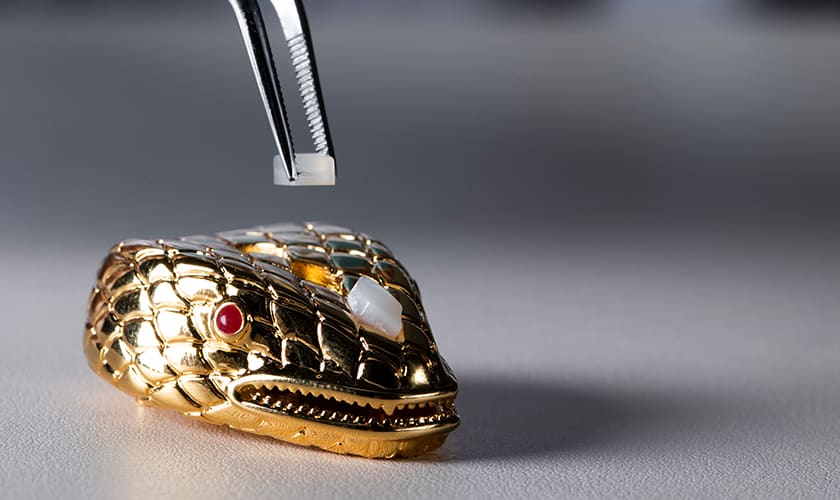
Most jewellery brands show you the finished piece. The polished surface catching studio light at the perfect angle. The gemstone glowing against a pristine white background. The clasp photographed so beautifully you can almost feel its satisfying click. What they don't show you is everything that happened before — the hands, the decisions, the moments where something was almost right but not quite, the rejections, the reworkings, the quiet hours of skilled labour that separate a piece of jewellery from a piece of excellence.
We think those hidden moments matter. Because that's where the quality actually lives. The difference between good jewellery and great jewellery isn't visible in the final product — it's embedded in every choice made along the way. So here, for the first time, is a detailed look at exactly what happens inside the LOTTEDS atelier. From raw 316L steel to the finished piece on your skin — this is the journey.
7:30 AM — The Livia Protocol Begins
The workday at LOTTEDS doesn't start with machinery. It starts with skin.
Before any new design is approved for production — before it even reaches the casting stage — it must survive what the atelier team calls "the Livia Protocol." Our founder, Livia, takes the prototype home. She wears it. Not for an hour. Not for a photo shoot. For days — through morning routines and school runs, through hand washing and typing, through workouts and cooking and the general beautiful chaos of life with two children. She wears it to sleep. She wears it in the shower. She wears it until she forgets it's there — or until it makes its presence known in a way that isn't acceptable.
If the piece irritates her skin — even faintly — it goes back to the designers. If it catches on clothing, snags on hair, or makes an unexpected sound when she gestures, it goes back. If it feels heavy after a full day of wear, or if the clasp requires too much concentration to operate one-handed, or if the edge of a stone setting feels even slightly sharp against the pad of her finger, it goes back.
The Livia Protocol has killed more designs than any other part of the LOTTEDS process — and that, Livia will tell you, is exactly how it should be. "A piece of jewellery is not complete when it leaves the workbench," she says. "It's complete when someone puts it on and forgets they're wearing it. Until that happens, it's still in development."
Only after a design has passed Livia's personal testing — days of continuous wear without a single moment of discomfort — does it move to the production floor.
8:00 AM — Material Inspection
The production day begins with raw materials. Every batch of 316L stainless steel that arrives at the atelier is tested before it enters the workshop. Not visually. Not with a quick glance and a nod. With spectrometry — a technique that analyses the exact chemical composition of the metal by measuring the wavelengths of light it emits when vaporised. The machine produces a readout showing the precise percentages of chromium, nickel, molybdenum, carbon, and every other element in the alloy.
If the chromium content is below 16%, the batch is rejected. If the molybdenum is below 2%, rejected. If the nickel content is high enough to risk failing the EU Nickel Directive (EN 1811) standard for prolonged skin contact, rejected. Approximately 8% of incoming materials fail this inspection. They go back to the supplier. They never become LOTTEDS jewellery.
The same rigour applies to gemstones. Every shipment of lab-grown diamonds and moissanite is inspected for colour consistency, clarity, and cut quality. Stones that don't meet our premium-grade standards are returned. We'd rather run low on inventory than set a substandard stone.
Material Inspection
Every batch of 316L steel is spectrometrically tested for exact chemical composition. Every shipment of lab-grown stones is graded for colour, clarity, and cut. Approximately 8% of incoming materials are rejected and returned to suppliers before they ever touch a workbench. This is the first filter — and one of the most important. If the raw materials aren't right, nothing that follows matters.
9:00 AM — Precision Casting
Once the materials pass inspection, the designs — finalised by Bob and the collective, modelled in 3D CAD, stress-tested for clasp durability and stone setting security — move to casting.
Casting 316L stainless steel is more demanding than casting gold or silver. The melting point is higher — approximately 1,400°C, compared to around 1,064°C for pure gold. The tolerances are tighter. The flow characteristics of molten steel are different from precious metals — it's more viscous, less forgiving of imperfect mould geometry. One air bubble in the wrong place, one degree of temperature deviation, one second too long or too short in the cooling phase, and the entire piece is scrapped. Unlike gold, which can often be re-melted and re-cast with minimal loss, a failed 316L casting usually means starting over from raw material.
This is one of the reasons most affordable jewellery brands don't use 316L steel. It's harder to work with. It requires more expensive equipment. It demands more skill from the casting team. Fast-fashion jewellery brands use brass because brass melts at around 900°C, flows easily into intricate moulds, and is forgiving of the kind of minor process variations that are inevitable in high-volume production. LOTTEDS uses 316L because it's better for the person who will wear the finished piece — even though it's harder for the people who make it.
Precision Casting
316L steel is cast at approximately 1,400°C — nearly 350°C hotter than gold. Tighter tolerances. Less forgiving of imperfections. Every casting is inspected under magnification for porosity, incomplete filling, or surface defects before moving to finishing. The rejection rate at this stage is approximately 5% — pieces that don't meet our standards are recycled. 316L is 100% recyclable.
11:00 AM — Hand Finishing
This is where the human hand becomes irreplaceable.
Every LOTTEDS piece is hand-polished by artisans who have been doing this work for years — in some cases, for decades. There are machines that can polish metal. There are tumblers and vibratory finishers and automated buffing wheels. None of them can replicate what a skilled human hand can achieve: the subtle softening of edges, the uniform reflection across a curved surface, the way light wraps around a contour rather than bouncing off a sharp angle.
Machine finishing leaves a surface that is technically polished — but it lacks nuance. The abrasives follow a predetermined path, applying the same pressure regardless of the geometry they encounter. A human polisher adjusts — applying slightly more pressure to a recessed area, easing off at a delicate edge, working a curved surface with a motion that follows the curve rather than cutting across it. The difference is visible, but it's also tactile. Run your finger over a hand-polished LOTTEDS surface and a machine-polished equivalent, and the hand-polished one feels warmer, smoother, somehow more intentional.
The polishing compounds used are progressively finer — starting with a relatively coarse compound to remove casting marks and surface irregularities, then moving to finer and finer grades until the final mirror finish is achieved. The last stage uses a compound so fine it feels like silk between the fingers. The entire process takes 20–45 minutes per piece, depending on complexity. It's the single most time-intensive stage of production — and one of the reasons LOTTEDS pieces have that distinctive, liquid-metal lustre that's impossible to achieve through automated finishing alone.
Hand Finishing
Every piece is hand-polished by artisans using progressively finer compounds. Machine finishing can't replicate the subtlety of a human hand adjusting pressure to the geometry of each surface. This stage takes 20–45 minutes per piece and is the most labour-intensive part of production. The result is the signature LOTTEDS mirror finish — warm, liquid, and impossibly smooth to the touch.
1:00 PM — The PVD Chamber
After hand finishing, the polished pieces enter the PVD (Physical Vapour Deposition) chamber. This is the technology that separates LOTTEDS gold from the electroplated finishes that fade within months — and it's worth understanding exactly how it works.
The PVD chamber is a sealed vacuum vessel. The air is evacuated until the pressure inside is lower than the surface of the moon. Solid 18K gold — real, certified, 18-karat gold — is bombarded with high-energy ions until it transforms from a solid directly into a plasma: a superheated gas of individual gold atoms, stripped of their electrons, glowing with an eerie purple-blue light. This plasma is accelerated toward the jewellery surface using electromagnetic fields. The gold atoms strike the 316L steel at velocities that embed them into the metal's crystal lattice — not on top of it, but within it.
The bond that forms is not adhesive. It's not a coating. It's a metallic bond — the same type of bond that holds the steel itself together. The gold becomes, at the atomic level, part of the surface of the piece. It cannot flake. It cannot peel. It cannot wear away to reveal a different metal underneath — because there is no "underneath." The gold is the surface, permanently.
This is the same technology used to gold-plate the cases of luxury Swiss watches — timepieces that are worn daily for decades and retain their colour throughout. It's more expensive than electroplating. It requires more sophisticated equipment. It takes longer per batch. But the result is a gold finish that lasts for years rather than months — and that, for LOTTEDS, is the only acceptable standard. Read the full PVD vs. traditional plating comparison →
The PVD process in numbers: Chamber pressure: lower than 10⁻⁵ torr (near-perfect vacuum). Gold plasma temperature: approximately 3,000°C at the point of vaporisation. Deposition rate: controlled at 0.5–2 microns per minute for optimal bonding. Total cycle time: 30–90 minutes per batch, depending on the desired colour intensity and the complexity of the pieces.
PVD Chamber
Solid 18K gold is vaporised into plasma and accelerated into the 316L steel surface at high energy. The gold atoms embed into the metal's crystal lattice — forming a permanent metallic bond, not a surface coating. This is the same technology used by luxury Swiss watch brands. The process takes 30–90 minutes per batch and uses more gold per piece than electroplating — but the result lasts for years, not months.
3:00 PM — Stone Setting
For pieces that include lab-grown diamonds or moissanite, the next stage is stone setting. This is done entirely by hand, under magnification, by setters whose steady hands and precise eyes have been trained over years of practice.
Each stone is placed into its setting and secured — usually with prongs (tiny metal claws that fold over the stone's edge) or in a bezel (a continuous metal rim that encircles the stone). The setter checks each stone for security by applying gentle pressure from multiple angles. A loose stone is the single most common jewellery failure — and it's almost always caused by rushed setting. A setter who is pressured to work quickly will leave microscopic gaps between the stone and its setting — gaps that widen over time as the piece is worn, eventually allowing the stone to shift, rattle, or fall out entirely.
LOTTEDS setters work at their own pace. There's no quota. No timer. No incentive to hurry. The quality of the setting is the only metric that matters. After setting, each stone is inspected under 10× magnification to confirm it's seated correctly, aligned with its neighbours (in multi-stone pieces), and secured with consistent prong pressure around its entire circumference.
Stone Setting
Lab-grown diamonds and moissanite are set by hand under magnification. No quotas. No timers. Each stone is tested for security, then inspected under 10× magnification to confirm alignment, seating, and consistent prong pressure. Loose stones — the most common jewellery failure — are almost always caused by rushed setting. We eliminate the rush.
4:30 PM — The Final Inspection
Every single LOTTEDS piece — not a sample, not a random selection, every single one — goes through a two-person independent inspection before it's cleared for packaging.
The first inspector examines the piece under 10× magnification. They check for:
- Stone security: Each stone is gently probed to confirm it's locked in its setting.
- Surface finish: The mirror polish should be uniform across the entire piece — no dull spots, no polishing marks, no areas where the PVD colour is inconsistent.
- Clasp function: Every clasp, hinge, and closure is operated multiple times to ensure smooth, reliable action.
- Engraving clarity: Any hallmark engravings should be crisp, legible, and correctly positioned.
- Overall aesthetic: Does the piece look right? Does it catch the light the way it should? Does the colour match the reference sample? This is the subjective, experienced-eye check that no machine can perform.
The second inspector repeats the examination independently. Two pairs of eyes, two professional judgments, no consultation between them until both have completed their assessments. If either inspector flags an issue, the piece goes back for rework. If both sign off, it moves to the final stage.
Approximately 5% of pieces fail final inspection. Those that can be reworked — a surface finish issue, a stiff clasp — go back to the relevant station. Those with structural issues — a casting defect that wasn't caught earlier, a stone setting that won't hold — are recycled. 316L steel is 100% recyclable. Stones are carefully removed and either reset in a new piece or returned to our gem supplier. Nothing goes to landfill.
Final Inspection
Two independent inspectors examine every piece under 10× magnification. Stone security, surface finish, clasp function, engraving clarity, overall aesthetic. Both must sign off. Approximately 5% of pieces fail this stage and are either reworked or recycled. Nothing leaves the atelier without passing two sets of expert eyes.
5:30 PM — The Livia Check
Random pieces from every production batch — not selected by the production team, but pulled at random by Livia herself or a member of her team — go through one final test: Livia wears them. Not for minutes. For days. The same protocol that killed designs during development is applied to finished production pieces as a continuous quality audit.
This is not an efficient system. It's not scalable in the way that automated quality control is scalable. Livia knows this. She does it anyway — because she made a promise in 2020, at her kitchen table, with $3,200 in savings and a folder full of photographs of irritated skin, that every piece bearing the LOTTEDS name would pass the skin test. She intends to keep that promise for as long as the company exists.
Livia on quality: "I spent 12 years listening to people who'd been disappointed by jewellery. The rashes. The green marks. The gold that faded. The stones that fell out. Every single one of those failures was a choice — a choice to use a cheaper material, a faster process, a lower standard. We make different choices here. Not because we're virtuous. Because I refuse to add any more photographs to that folder."
The Livia Check
Random pieces from every batch are worn by Livia for days as a continuous quality audit. Not efficient. Not scalable. But it's the promise she made in 2020 — every piece must pass the skin test — and she intends to keep it. This final, personal check ensures that what leaves the atelier meets the standard set at her kitchen table five years ago.
What Happens to the Pieces That Don't Pass?
Transparency means showing the whole picture — including the parts that aren't flattering. At each stage of production, pieces are rejected. At material inspection, about 8% of incoming steel and stones are sent back. At casting, about 5% of pieces have defects — porosity, incomplete filling, surface irregularities — that mean they can't move forward. At final inspection, another 5% are flagged.
These pieces are not hidden. They're not sold as "seconds" through a discount channel. They're not shipped to customers who might not notice the flaw. They are recycled. 316L stainless steel is one of the most recyclable materials on Earth — the global recycling rate for stainless steel exceeds 85%. Failed castings are melted down and returned to the material supplier. Stones are carefully removed and either reset in new pieces or returned to our gem supplier. Nothing goes to landfill. Every gramme of metal and every stone is accounted for.
This is not a marketing claim. It's standard manufacturing practice in any facility that works with high-grade materials. But we mention it because the jewellery industry has a history of opacity — and we believe transparency about failures is as important as transparency about successes.
Why This Matters
When you hold a LOTTEDS piece — when you unbox it, try it on, wear it for the first time — you're holding something that passed through at least seven checkpoints. Multiple pairs of hands. Multiple inspections. Multiple rejections along the way — not of the piece you're holding, but of other pieces that didn't meet the standard. The piece in your hand is a survivor. It was chosen, repeatedly, at every stage of its creation.
We're not the fastest. We're not the cheapest. There are jewellery brands that can take a design from sketch to shipping in weeks — using brass, electroplating, and automated finishing, cutting every corner that can be cut. That's not our model. We build every piece like it's going to be worn by someone who's been disappointed by jewellery before — someone who's developed a rash from a "gold" necklace, scrubbed green residue off their finger, had a stone fall out of a ring they loved. Someone who refuses to be disappointed again.
That person deserves jewellery made with care. Not with speed. Not with shortcuts. With the quiet, unglamorous, utterly essential attention to detail that happens in the hours before the shine.

See What Comes Out of the Atelier
Every piece that passes our seven-stage process ends up in collections like Bob and Giorno. Hand-finished. PVD gold. Lab-grown stones. Built to last.
Bob Collection → · Giorno →
The Snake Collection: Hand-Polished Perfection
Every Snake chain is hand-polished for 20–30 minutes to achieve the signature LOTTEDS mirror finish. No machine can replicate the warmth of a hand-finished surface.
Snake Collection → · All Necklaces →
Rings That Survived the Gauntlet
Every LOTTEDS ring has been cast, polished, PVD-coated, set, and double-inspected before it reaches you. The result: a ring that looks as good in year five as it did on day one.
Shop Rings → · Rollers →
Deixe um comentário